Growing up, I was always so sure there were two kinds of people in the world: the ones who were math people and the ones who were not. I believed that I was the kind who wasn’t really a math person but could work hard enough to make it work for my STEM classes—that is until I came to Hopkins.
During orientation week, there is a special event called Department Open Houses. These are walk-in events where you explore the 100+ majors and minors at Hopkins. Coming into college, I wanted to double major in computer science and economics. I hadn’t really considered much else beyond that. Still, I decided it couldn’t hurt to visit the open houses for a few departments and see if there were any interesting classes. The first one I visited was the applied math and statistics open house. Going in, I wasn’t considering this as a major or minor but knew I was going to take a few classes in the department for my computer science requirements.
During the session, the Director of Undergraduate Studies of the Department of Applied Mathematics and Statistics (AMS) painted a clear picture of what being an AMS major or minor would be like. He went over classes, but more importantly, the possibilities involved in math. There are AMS classes that are relevant to biomedical data science and quantitative finance. AMS majors have become applied mathematicians, data scientists (the kinds of professions I expected AMS majors to do), and gone on to medical school and law school. This was a complete surprise to me and just a testament to how versatile a skillset math can give you. I realized no matter what I wanted to do, I could be a “math person,” and just about anybody could be one too.
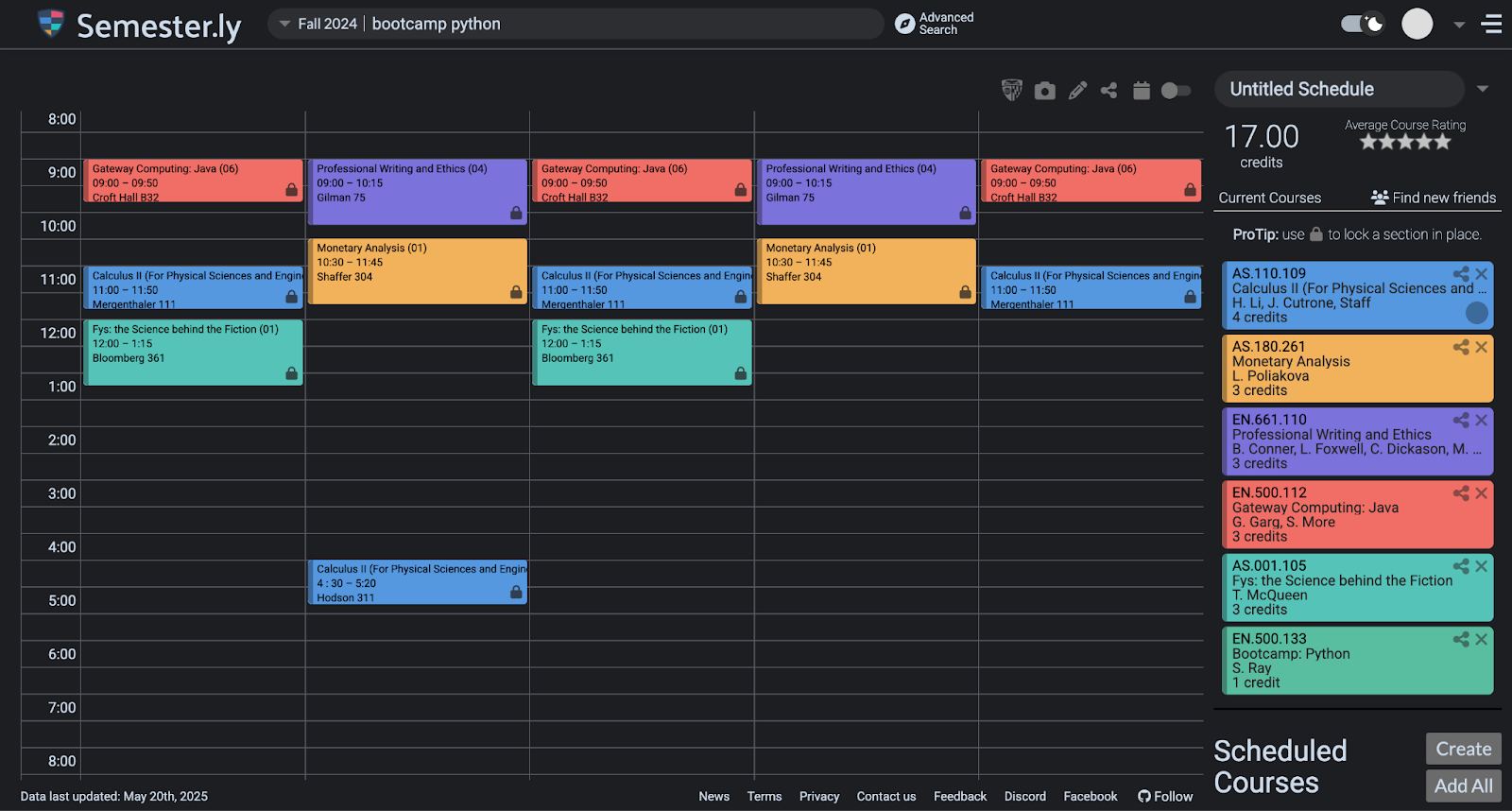
The reason is just how many free resources the AMS and pure mathematics departments provide to the students. Teaching assistants, course assistants, and professors all host office hours. There is also 1-on-1 learning den tutoring and PILOT support for a lot of the courses. In the previous sentence, I mentioned AMS and pure mathematics. These are actually two completely different departments at Hopkins. The Department of Applied Mathematics and Statistics is in the Whiting School of Engineering. It includes classes like Linear Algebra for Data Science, Cryptology and Coding, Investment Science, etc. (as I mentioned before, there is something to complement every interest here).
The Department of Mathematics is in the Krieger School of Arts and Sciences, and you take classes like Calculus 1, 2 and 3, Introduction to Proofs, Elementary Number Theory, etc. Most students majoring in AMS take classes in the Department of Mathematics as well. I have experience in both because I am a TA (Teaching Assistant) for a class in the pure mathematics department but am working towards a minor in AMS.
Learning I could be a “math person” opened new possibilities for me beyond classes too. It empowered me to think more boldly and plan out new projects and goals. One thing I want to start during my time at Hopkins is a “moonshot project.” By this I mean a project that may sound impossible right now but possibly wouldn’t be so in the future. After all, if even I can be a “math person,” a moonshot may not be so far away.