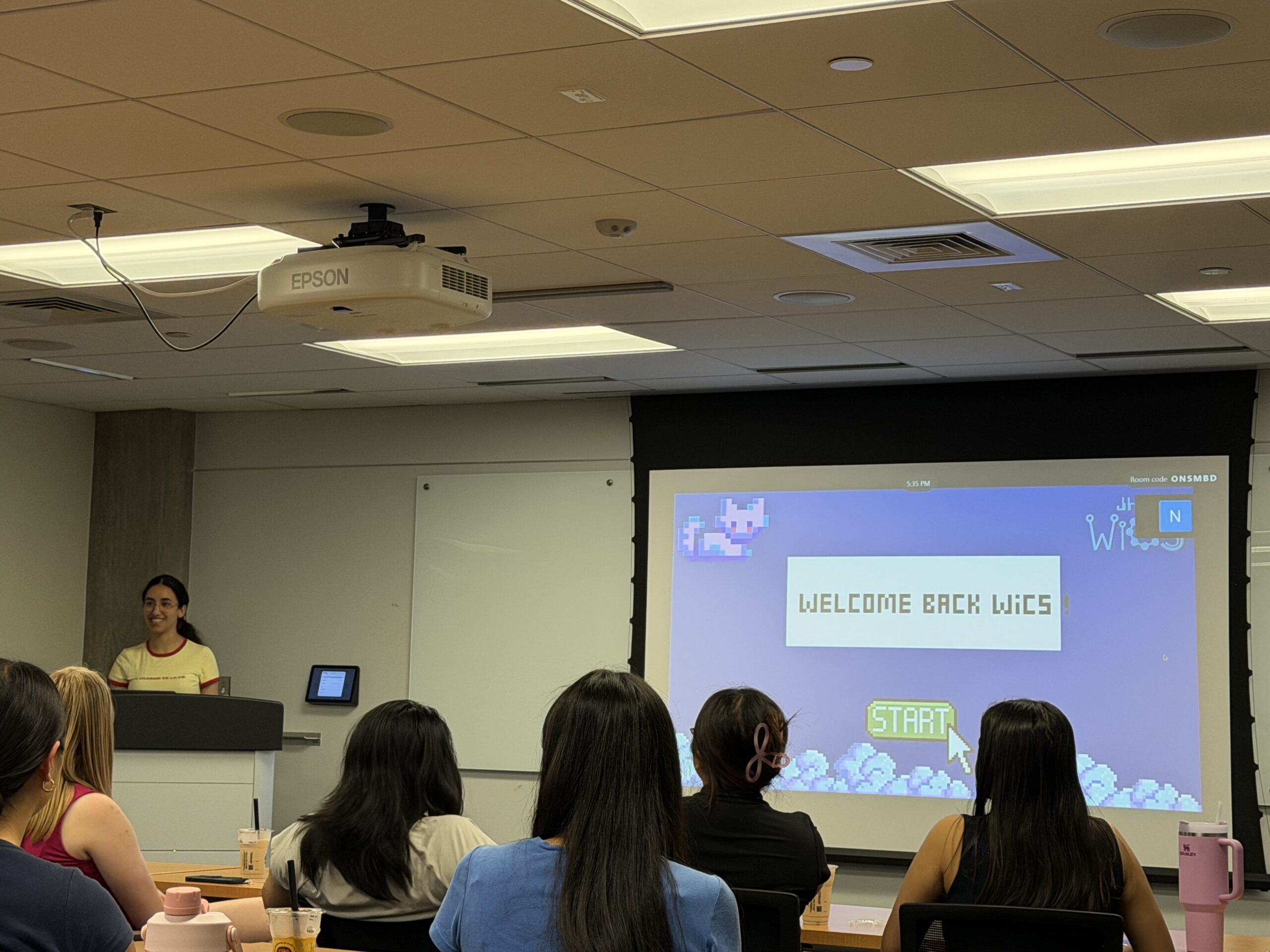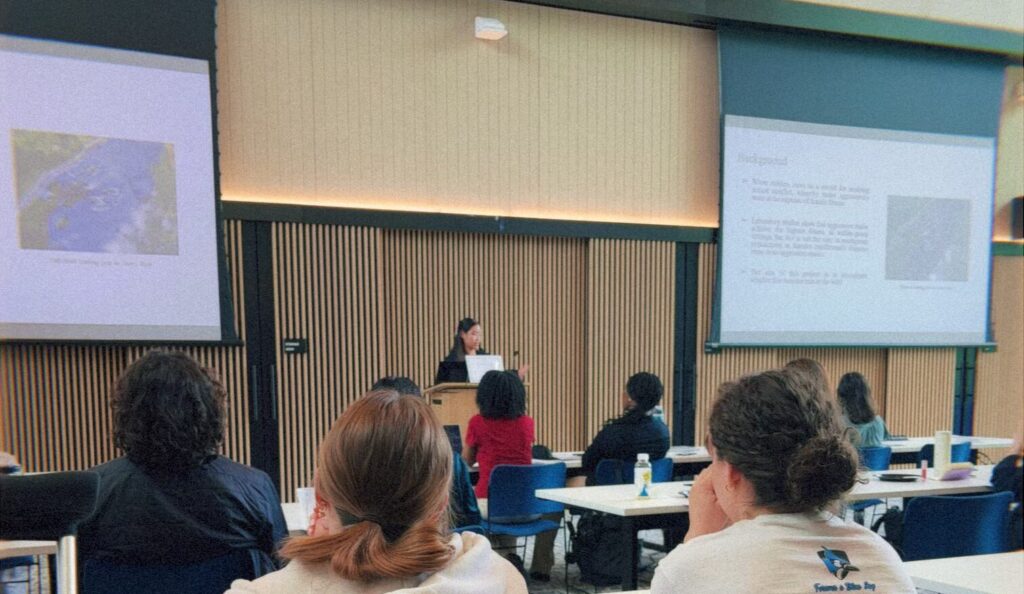
In April, I presented at two symposiums hosted by Hopkins as part of my grant (summer Provost’s Undergraduate Research Award or PURA). Not only could I share my work virtually at Hopkins’ Research, Experiential, and Applied Learning (REAL) symposium, but I was also able to share my work in person at the Psychology and Brain Sciences Symposium earlier that month.
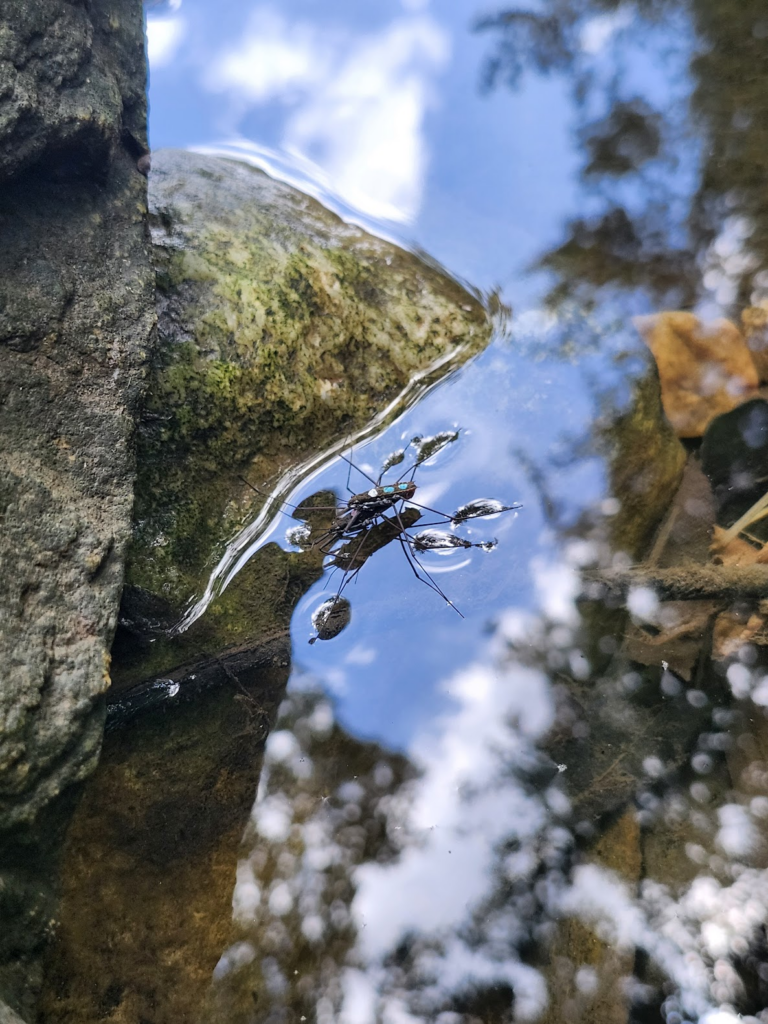
I’m involved in field research, which is different from clinical or wet lab work. Last summer, I worked on the Stony Run stream (which is right on campus!) to track and record the aggressive behavior of water striders. We collected data about the distance these striders dispersed, the aggressive behaviors of male striders, and the sex ratios of striders present in each pool. Striders reside in low flow areas called pools, making it relatively easier to know where to look for them. We used the aggressive behaviors noted during focal observations to curate aggression scores for each individual male. These were then used to correlate dispersal distance in both females and males to the aggressiveness of the nearest male strider as well as the average aggression of males in any given pool. Sometimes, the males were super calm and just hung out on the water. Other times, however, males continuously attacked females and one even appeared to drown a nymph (baby strider).
Over the past two semesters, my principal investigator (PI) and I have been analyzing all the above data and compiling it into presentable formats like a manuscript, a poster, and a slide deck. I used these to help me share my findings with members of the Hopkins community. We are also planning on presenting at an international conference, the Animal Behavior Society, in July! Shameless plug right here, but the behavioral biology department at Hopkins is the best department here (my opinion, of course). But an insider (haha Hopkins Insider, get it?) scoop could be found in some of my previous articles here and here. Through the program, I’ve been exposed to so many more aspects of academia and research than I ever would have thought existed.
My experience is unique in that my PI is also new to Hopkins, so we were able to start a research project together. Most students join an ongoing project with a PI who is an expert on an area they are interested in. So, it’s been really special for me to be able to see my project get built from the ground up and be involved in the entire process. Not only did I collect the data and do analyses, but I also got to brainstorm ideas, conduct literature review, and draft hypotheses. This brought my PI and I closer and we were able to work with each other from start to finish. This isn’t to say my way is the only way to develop a relationship with professors and PIs. A number of my friends have developed similarly close relationships with their PIs or post-doctoral fellows in their labs. One of my friends is in regular contact with his post-doc and meets his PI every so often just for a chat.
It’s so special that as undergraduate students, we get to participate in research and lots of us get to present our work and set foot into the scientific side of academia. Through undergraduate research symposiums, like I have done, or larger international conferences, like Animal Behavior Society, the opportunities we get to share our work are truly unmatched. Research at Hopkins as an undergraduate is supported by the entire community of academics. I’ve felt nothing less than support from those around me. Everyone truly just wants to see their students and the young people in their field succeed, so they always cheer us on and help us find opportunities.
Another benefit of research at Hopkins is the size of the network we have access to. Not only are we encouraged to do research with any of the faculty on Homewood campus, but Hopkins undergrads can also conduct research with the medical campus, the Bloomberg School of Public Health, the Bayview Medical Center, and any other center associated with Hopkins. My research takes place on the Homewood campus, where our undergraduate students are. However, nearly all of my friends conduct research at the medical campus. Whether it’s engaging with patients in clinics or in the hospital, or working in a wet lab attached to the medical campus, Hopkins undergraduates can explore research that would only be reserved for grad students or hired lab techs at other institutions.
Writing about this has me so excited about scientific inquiry and made me realize that there is no cap on how much research we can get involved in! I work for two research labs: my field research on campus, and a clinical project at the medical campus. I found my field research by approaching my PI after a talk he gave during orientation week. I talked to him again after the first meeting of the course he taught a week later. We got to brainstorming and somehow are on the closing steps of our work now.
I found my clinical work on the pre-health newsletter (pro tip: read the newsletters!!). It was a quick few sessions of onboarding and training, and then I got to get started. On the medical campus, I walk around two separate units and interview patients. These interviews are a simple set of questions that play during rounds (when physicians and nurses go around the unit and debrief updates on each patient). After a few weeks of the interviews being played, we talk to patients again and gauge their level of perceived empathy from physicians and nurses. I love this project for very different reasons than those for why I love my field work, but each has their own special spot in my brain. On the field, I satisfy the nature nerd in me. I get to spend hours caring for animals and observing their behavior. On the units, I get to make meaningful connections with patients and nurses and be in the environment where I hope to dedicate my life to caring for people empathetically. Dua, whom I’ve written about plenty, is another one of my friends who also has multiple ongoing research projects through Hopkins with the Anthropology department (her honors thesis!) and the Grados Lab for psychiatric research on the medical campus. Genuinely, when I say there is no limit, there is no limit to the exploration that students can conduct at Hopkins.
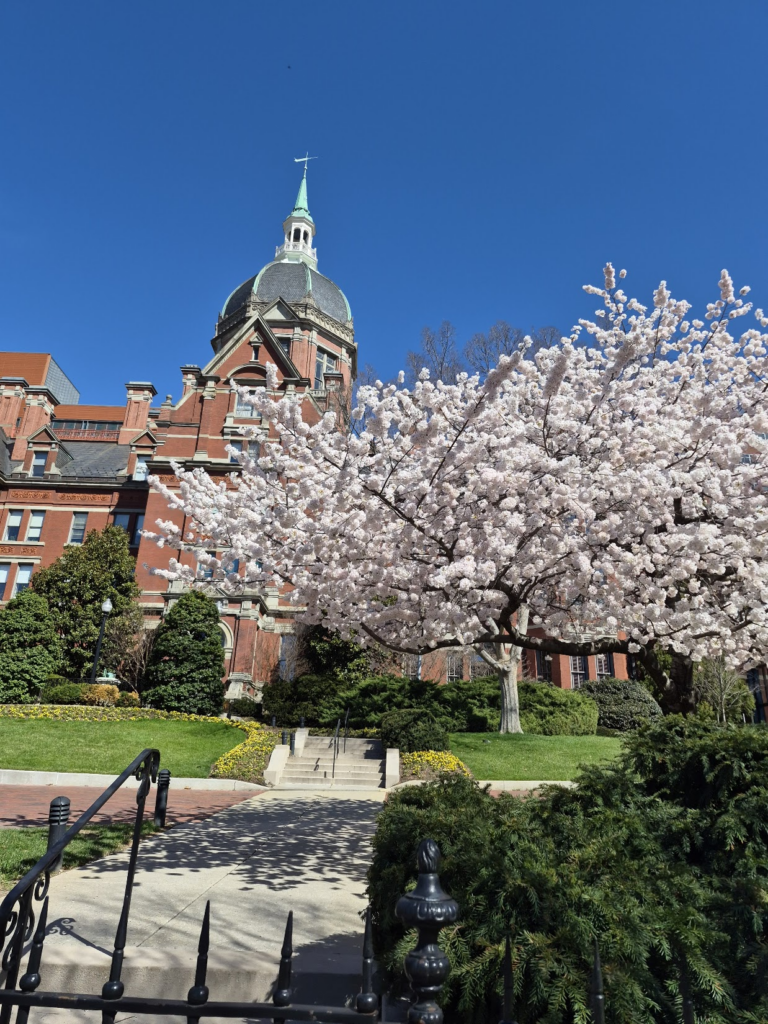
I’m in my research groove now, so I’ll catch the JHMI shuttle over to the medical campus and chat with some of my favorite patients. Tell me about your ideas, I’d love to have a geek-out session with you!