Purple, Red, Green, Silver…free, sometimes free, $2, $4…pull the yellow wire? Am I really in Baltimore or am I in Wonderland? Figuring out public transport can be difficult when you’ve never had to use it a day in your life, which is why I’ve put together this guide.
The City
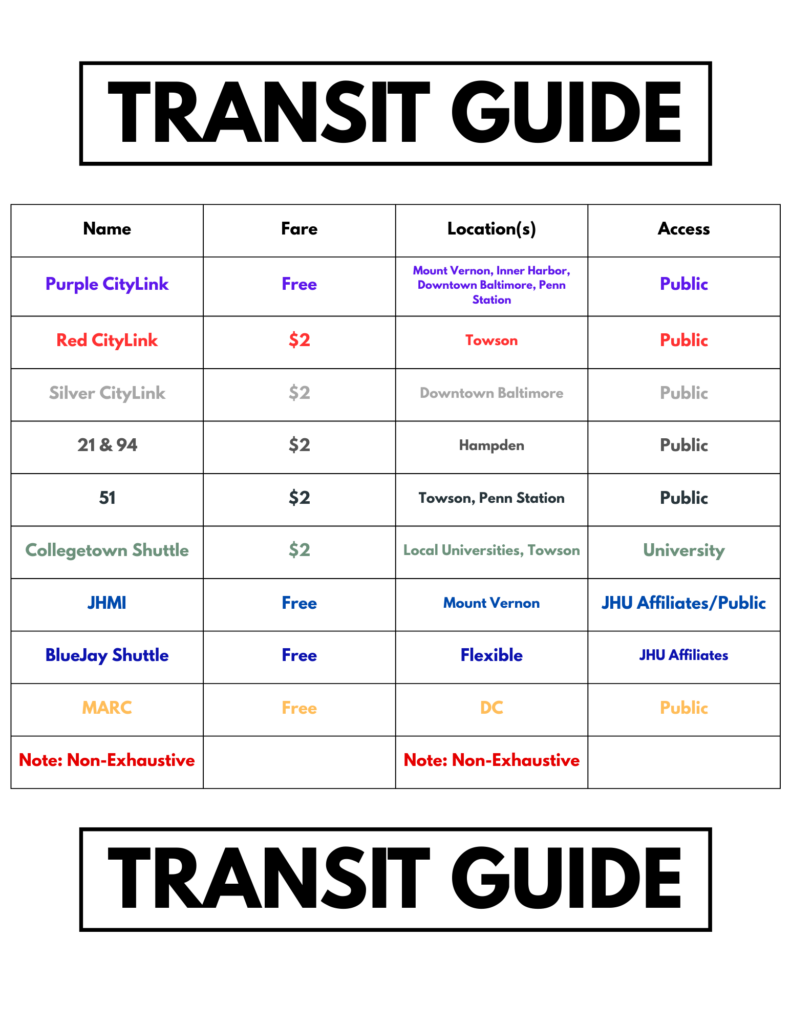
The CityLink buses (Charm City Circulators) have 12 different colored routes. Each color has a designated region, and there is some overlap.
These are the ones close to Hopkins:
The Purple route
💲 Cost: Free
📍 Destination(s):
- Mount Vernon (the Peabody Institute and the Walters Art Museum are located here)
- Inner Harbor (National Aquarium, Maryland Science Museum, and seasonal activities and festivals are hosted here)
- Downtown Baltimore (You can catch the Orioles at Camden Yards and the Ravens at M&T Bank Stadium)
- Penn Station (Regional trains like Amtrak and the MARC)
The Red route
💲 Cost: $2
📍 Destination(s):
- Towson (Towson Mall is popular among Hopkins students)
The Silver route
💲 Cost: $2
📍 Destination(s):
- Downtown Baltimore
In addition to the CityLinks, Baltimore also has local link buses, differentiated by numbers:
21 & 94
💲 Cost: $2
📍 Destination(s):
- Hampden (Rotunda Warehouse Cinema is popular among Hopkins students)
51
💲 Cost: $2
📍 Destination(s):
- Towson
- Penn Station
The University
Besides Baltimore public transit, there are forms of transport specifically for Hopkins students, staff, and faculty. All of these options are free.
collegetown shuttle
- University ID required
- Takes you to different college campuses across Baltimore and Towson
Hopkins JHMI (pronounced “jimmy”)
- Runs a circular route that takes you to the Peabody Institute, the Johns Hopkins Hospital and School of Medicine, and other locations (See: apps)
Hopkins Circulator Shuttles
- Runs from 8 a.m. to 6 p.m.
- Takes you to the Remmington neighborhood (R. House is a popular food hall students go to), Hampden neighborhood, and between campuses
Hopkins Blue Jay Night Shuttles
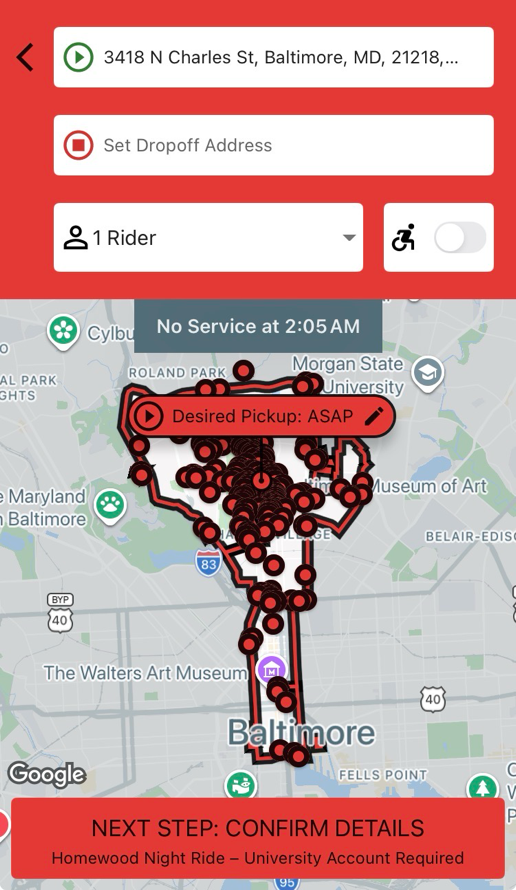
- On-demand, curb-to-curb service from 6 p.m. until 2 a.m.
- Must book through the Transloc app
- Hours are more flexible than most of the other transit options here
- Service area is limited (see below)
PRO TIP: If you request a night shuttle and it doesn’t arrive within 20 minutes, you get a free Lyft to your destination!
Beyond Baltimore
To catch a train, you will need to travel to Penn Station. Only a 17-minute bus ride from campus, Penn Station is where you can board trains traveling to DC, New York, Virginia, or another area.
- Amtrak is a company that runs passenger trains all over the United States. Rates vary though it is usually cheaper if you book your tickets (on the Amtrack app) well in advance.
- One of the cheapest ways to travel to DC specifically is using the Maryland Area Rail Commuter (MARC). You can buy a ticket online in advance (Using the CharmPass app) or at the kiosk inside the station. This is also a good way to get to and from BWI Airport.
Now that we’ve gone over some of the available forms of transportation, let’s see what using public transit can look like.
Scenario 1: Trip to Towson
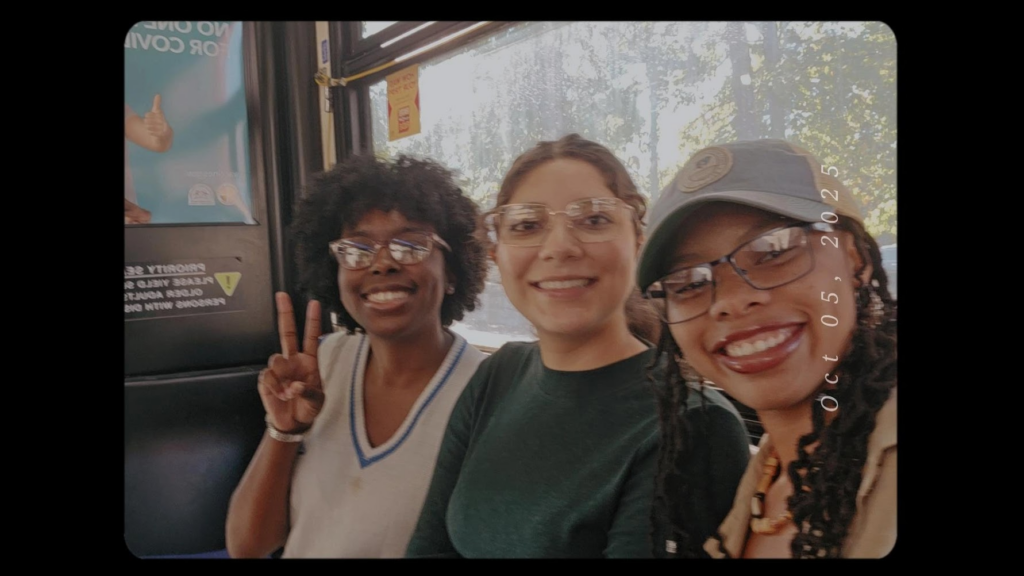
Myself and two of my friends, Atarah and Vany, are going to the Towson Mall (Towson is a suburb about a 35-minute bus ride from Hopkins). Since Atarah is a Peabody Double Degree student, she lives at Peabody. To get to Homewood campus (where Vany and I live), she takes the JHMI. To get to the mall, we can take the Collegetown Shuttle, which would mean we won’t have to pay anything, and we won’t have to switch to another vehicle to make it there.
Unfortunately, Atarah has forgotten her student ID at Peabody. So, we will get to Towson using the Charm City Circulators. Looking on Apple maps, I see that we will either have to take at least two buses (Red and Silver), with a fare of $2 each, or we will take one bus and walk part of the way. We will take two buses and walk less because I was at the gym yesterday and my hamstrings are sore. Since we will be using a total of four buses today (two there, two back), we buy the $4.60 all day bus passes on CharmPass which saves each of us $3.40.
After five stops, we get close to the area where we are supposed to catch our next bus. Vany lightly pulls down on the yellow wire hanging above the window to indicate to the driver there are passengers getting off at the next stop.
Scenario 2: Saturday in DC
The day before we leave, I buy a MARC ticket using CharmPass. My train departs at 2:50 p.m. I will take the Purple Circulator to Penn Station. Since I plan to return to Baltimore after 7 p.m., and the Blue Jay Night Shuttle will be running by then, I will not buy the all-day pass. Penn Station is 17 minutes away from Homewood campus, but it is 2:20 p.m. and my bus is running late. Another bus pulls up to the stop, right across from Scots-Bates Commons (a residence and dining hall on N. Charles Street), but it isn’t the one I am waiting for. I step on and ask the driver whether or not she will be passing by Penn Station; she says yes, it is her fourth stop. I decide to take this bus instead and arrive on time.
Apps
To find out which buses and shuttles are running, there are a few helpful apps.
- For Baltimore City Transportation
The map app on your phone: Whether it’s Google or Apple maps, you can use whatever maps app you already have downloaded on your phone to find Baltimore public transit bus routes. It will tell you bus fares, when they are estimated to arrive at the nearest stop, and estimated ETA.
The CharmPass app: This is where you can buy tickets for the buses that have a fare. I recommend the $4.60 all-day pass if you have to take more than two buses to get somewhere and back.
The Transit app: This can be used to find which buses are running and the closest stop near you. It also has information about the MARC (See: Beyond Baltimore) trains and the Light Rail. It provides you with the same information as your maps app.
- For University Transit
Transloc: This must-have app can be used to find out which forms of transport can take you to your destination. This is the app you will use to schedule the Blue Jay Night Shuttle and view the JHMI and Collegetown Shuttle schedules.
Important things to know
- The ETA provided on any of the apps is not always accurate, which is why I recommend allotting at least a 20-minute buffer to get to your destination.
- Some bus drivers will not stop the bus if they see no one waiting at the stop. Or, if they do, it will be very brief. Once the driver has closed their doors, they will not reopen them. So, in addition to the 20-minute buffer, I recommend you arrive at your stop at least five minutes early.
- Fare enforcement can vary depending on the bus. If you don’t have the money to pay the bus fare and you need transportation, you can attempt to board the bus as the driver may not enforce the fare. That being said, in order for these services to remain running, funds are required. Your payment of the fare (when able) allows for this flexibility for those who are unable to pay the fare but require transportation.
- Ask the driver if they are going to the place you are headed. In my experience, drivers can be extremely helpful. If you don’t know something, it’s better to ask to ensure you arrive at the correct destination.
Why Public Transit?
I started off the semester with no idea how to use a bus, order a shuttle, or buy a train ticket. I never would have expected myself to become so comfortable using public transportation in just a few months. Learning how to navigate everything was a mixture of googling, phone calls, and firsthand experience. And because of this, I have been able to have so many wonderful adventures throughout Baltimore and DC.
I hope to run into you—on a bus, shuttle, or train, off having adventures of your own. Safe travels!