Every Hopkins student has been there: When it’s 6:59:59 a.m. and you’re hoping to press register at just the right moment. The countdown to course registration can be exciting, and sometimes confusing. Planning well is the key to a successful and balanced semester—one that supports your academic interests and well-being.
Through trial and error over the last few semesters, I’ve gathered a couple of tips for a triumphant course registration day, and I’m here to share those with you!
Tip #1: Plan, plan, and plan again
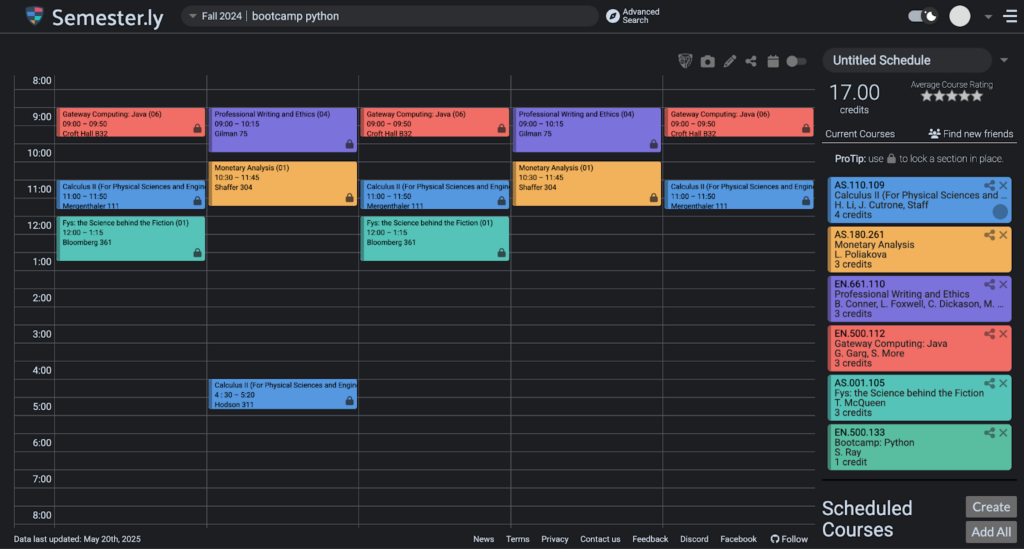
It isn’t possible to overemphasize the importance of planning when it comes to course registration. It allows you to structure your schedule so you can explore all your interests as you work on your degree requirements. I love using semester.ly (a tool made by Hopkins students to plan the perfect schedule) to explore different schedule combinations. The first schedule is my ideal version, but it is essential to have backup classes and sections. For four-year degree planning, I use Stellic (a degree planning tool). I mainly use my four-year plan to see different permutations and combinations of my courses (like what if I added a different minor?). This plan is a canvas for me to follow my curiosity and see which classes can fit into my schedule.
Tip 2: Think about your priorities
The most important thing is to make sure your next semester is what is best for you. For example, I like to have at least 40 minutes for lunch each day and avoid back-to-back classes (trust me, running to back-to-back classes with only a matcha from Brody Café to fuel you all day is not fun). I also like to spread my classes out over the week instead of having them all on a few days. These priorities look different for everyone. Some people want to avoid 9 a.m. classes at all costs and others evening classes. It’s imperative to evaluate when you work and focus best. By doing this, your schedule is not just a list of classes to attend each day, but also a framework that can help you thrive.
Tip 3: Optimize for balance
I’ve always tried to achieve some semblance of balance through taking on a course load with different types of classes. For example, I usually try to take a three-credit economics class alongside my computer science and mathematics classes to vary my course load. This makes the semester more interesting. You can read the syllabus or talk to a friend who has taken the class before to gauge the workload and how that would fit into your routine. Apart from the types of classes, it’s a good idea to also look at their locations. You don’t want to be running between the farthest points on campus in just five minutes. Classes often have sections in different buildings, so you can try to pick buildings that are close to each other.
Tip 4: Check your building’s internet speed
I suggest checking your building/dorm’s internet speed the night before. You could even try going to another building like Malone Hall for faster internet speed.
Tip 5: Embrace change in your schedule
Throughout the first week of every semester, I like to attend different TA sections and variations of my classes. This allows me to figure out which times work for me so I can get the most out of my day. Also, sometimes a particular instructor’s teaching methods might be more helpful for you than others. So, know that it’s normal and even expected that your schedule will change over the course of the first few days while you get the hang of your new routine. I sat in on multiple different sections of calculus III last semester to help me decide which one worked best for me.
Next semester, I’m taking a good mix of classes that include computer science classes, mathematics, economics, and even chemistry! I’m using next semester to explore these interests while fulfilling my degree requirements. I hope you can see how course registration day is an exciting milestone, and a bit of planning can go a long way.