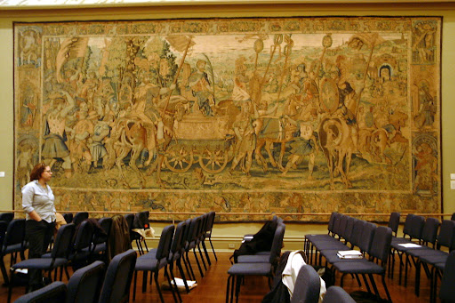
I am a math major at Homewood, but I’ve taken two semesters of for-credit lessons at the Peabody Institute, Hopkins’ music conservatory down the road. Last spring I took composition lessons and last fall I took piano lessons. In fact, my fall semester concluded at Peabody’s Griswold Hall, which seats 150, features a 400-square-foot tapestry, and was just softly lit enough that I could hold my nerve and perform one of Chopin’s nocturnes. Recitals—they never get old. Anyway, it was a nice way to end the semester! Performing at Peabody means something, I feel. But I am particularly proud of the work I put in throughout that year to make it to the stage.
When I originally came to Hopkins, I was inside somewhat of a musical shell. Every Thursday from the beginning of time until the end of high school (11 years), I’d gone to the Northampton Community Music School to meet Olga, an intimidating Russian lady who taught a killer piano lesson. Olga was a masterful musical guide. Then one day, I had my final lesson with her; and the day after that, it seemed, I was in Baltimore. Now what?
Let me tell you a secret about Hopkins: it is as impressive in real life as it is on paper—and that can be kind of dizzying for a rookie. When I got to campus, although I was aware of the considerable music opportunities down the road (and at Homewood!), I was also wrapped up in trying to find my footing among the considerable talent in my Homewood mathematics major. So, music-wise, I felt an inward gravity pushing me not only to stay at Homewood, but to go it alone. It was much easier this way, inside my shell.
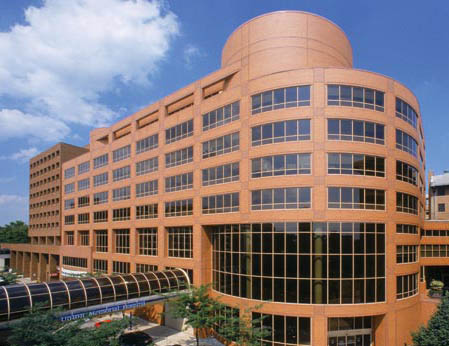
Thus began a surreal fall semester. Outside my window was a big marble church and a perfect brick horizontal circle in the sky, which turned out to be the top rim of a cylinder of the Medstar Union Memorial Hospital. Then one day I was walking by the church when a man came out and asked if I wanted to play the piano, and like that I was inside that unreal scene outside my dorm window. I spent an hour or two each weekday composing there, writing middling music.
Here is another secret about Hopkins, though: it will get you up to speed. Around me was this magnificent collection of human capital, and all these opportunities—and yet I was trying to see the place for the brick circles in the sky. Of course, my stuff sounded a little stale! As the semester went on, I started to hear Hopkins calling me out of that room atop the church lobby. I was in a new and fascinating place, and it was time to learn new music. Over fall break, I recorded myself playing a composition, entered my name, confirmed my email address, and applied for credited composition lessons.
Then it was January. I hopped on the shuttle to Peabody, spun up the big spiral staircase, and knocked. I was nervous. Dr. Adashi was my first new music teacher in 11 years. Would I understand him? Would he understand me? Why was there a tree bough on the floor of the classroom? “Yeah, I have no idea,” said the man at the desk. “Look, there’s a celesta on the piano too. Maybe they’re doing The Nutcracker?” And so we began talking. Not only was Dr. Adashi friendly, he was also knowledgeable. (Well, of course he was, you think all your professors are just your professors until you learn they made major contributions to the millennium falcon or something.) He understood the challenges I was having, and he let me talk through my doomed attempts at fixing them.
Over the course of the semester we talked about real solutions, with the understanding that composing is both hard and unwinnable. In particular, Dr. Adashi helped connect me to further musical resources. After learning I liked indie rock—in fact more so than Schoenberg—he pushed me to join the New Contemporary Tonality Club, or NCTC. (Peabody has a certain conservative skew in its musical culture, and so “fans of tonal music written within the last 100 years” is actually a meaningful, nontrivial distinction.) Anyway, those were my people. I would even consider one of them a mentor. When I was in Baltimore over the last summer, he made sure I knew what was going on musically, at Peabody and abroad. Dr. Adashi also introduced me to my favorite composer (big shoutout to Janacek). And then best of all, by May, I had a brand-new composition.
Come fall I decided I was ready to try pure conservatory piano. Composition was its own (very difficult) pursuit, but I was eager for some direction in piano after a year off. My teacher this time was another unassuming man, Tianyuan, with another ridiculous resume which included the words “competition,” “national,” and “1st prize,” in dizzying proximity. With Tianyuan, I began working on that Chopin nocturne (Op. 27 No. 1, one of my favorite pieces). First, we worked on control. Then we talked about narratives—and then it got really cool.
What if there was no narrative, I wondered? That is, what if the nocturne was best imagined as being independent of an emotional narrative? I ended up using this music-without-narrative idea in an essay for a Homewood class about the Holocaust. The coolest part was that the conversation wrapped around, and I found myself talking with Tianyuan about my essay. By the time I performed it, I had never known a piece better than I knew that nocturne.
That said, back up at Homewood a few hours later, celebrating with my friends and brownie crumbles at Honeygrow, I felt that Tame Impala’s The Moment, when it came blaring over the speakers, was a more fitting soundtrack. Chopin to chain-restaurant, oh well, corporate approves and so do I. “It’s getting closer ser ser ser ser ser ser….” Not being where I started, I thought as we exited into the night air, has never sounded so good.