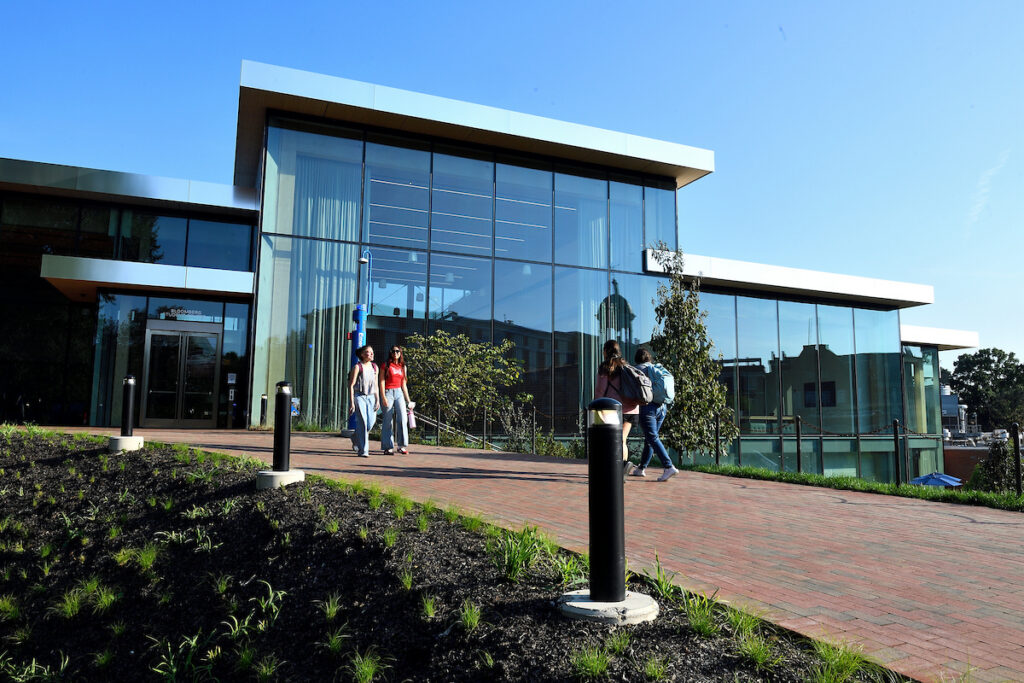
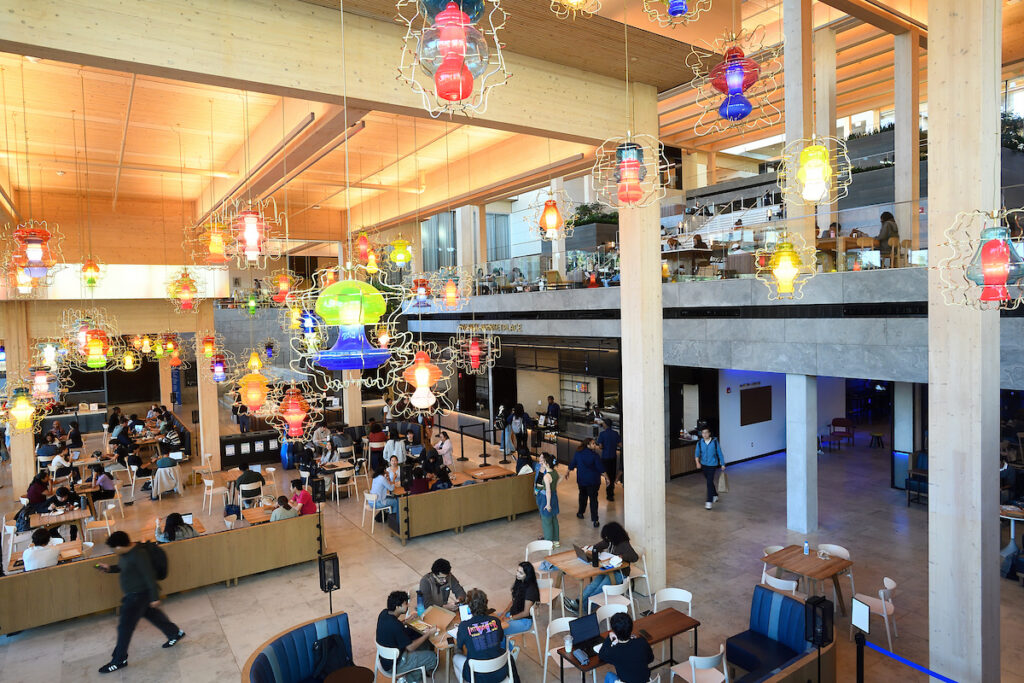
Today’s Hopkins students are coming of age in an era of profound change—architectural change, in particular. New structures are sprouting up all over campus at such a rate that it’s easy to forget how rare these developments are. The big example: if I had enrolled at Hopkins in any of its first 148 years, I would not have had access to a true student center. But instead, I came last year, and now as a sophomore the gleaming new Bloomberg Student Center is here. There is historical importance to the classes of (20)26—9. We did not get to experience the six lacrosse championships in eight years back in the 70s–80s, and it would’ve been cool to see Joan Baez take up temporary residence in Levering Hall, but we got the new student center first, and when the dust settles, your Koshary Smash Kebab Flatbread will mean more than you could ever know.
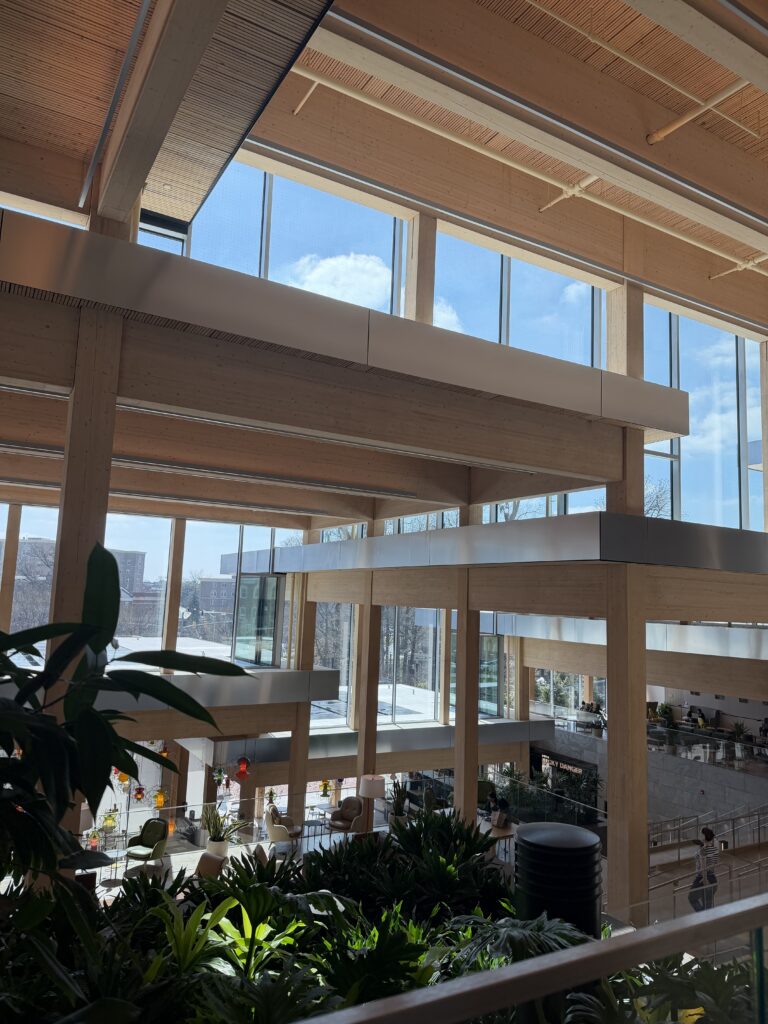
But the velocity makes it hard to contextualize. Just five years ago, a building called the Mattin Center stood in the plot across from Scott-Bates Commons. When I first arrived on campus two years ago, the skeleton of the Bloomberg Student Center (“the Stuce,” colloquially) had already replaced it. Now the center is done, open. The lighting is soft, and with all the new food options, the Dining Dollar has never been so powerful; students roost on the central stairs at all hours, and you can always spot someone you know there. The future of Homewood is now. But Homewood past is quiet. What was the old Mattin Center like? You might find the name on a memorial plaque on the bottom floor of the Stuce or on the back of a music stand. And what about before Mattin? Tell me about the old hearts of Hopkins student life. I am looking to have some connection to the dirt under my feet, and also to not take the Stuce for granted.
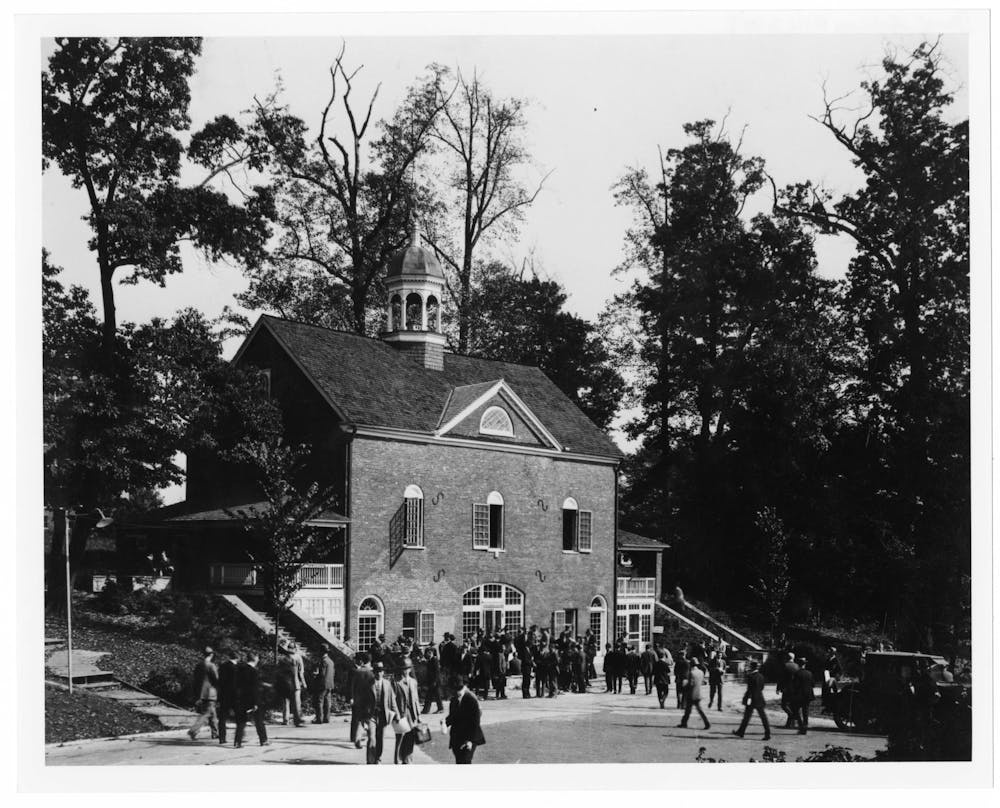
The first “student center” at the Homewood location was the Merrick Barn, a cow and horse barn constructed in 1803 by a signatory of the Declaration of Independence. When the school moved to Homewood from the Mount Vernon neighborhood in the mid 1910s, the barn became a hub for student life, featuring eating spaces, a barber shop, the office of “The News-Letter” (the student newspaper), and the HQ of an early iteration of the Barnstormers (the theatre group). The old stable proved resilient, continuing to act as a student center for 70 years until the 1980s, at which point it was really falling apart. The barn was then renovated and repurposed as the center of the theatre orgs on campus; it also gained the name “Merrick,” after Robert G. Merrick, Sr., who attempted to support the renovation anonymously, but was apparently too generous. What would Homewood life have been like back then with the barn as the student center? That is, with the ability to eat, get an oiled slick back, and catch a play under one little roof? Maybe this is a testament to the ability to be nostalgic for anything, but that sounds as cozy as a Christmas miniature, with all the different tiny shops in a row.
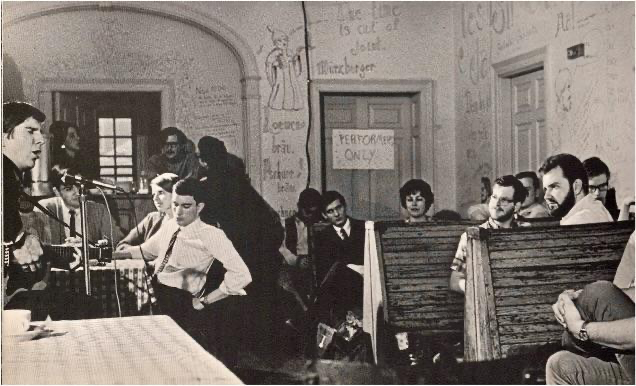
For most of its tenure as a student center, the Barn had a partner: Levering Hall. Levering was built in 1928 to serve as the university’s YMCA branch. It featured a cafeteria on the lowest floor, as it does today, and, in the 50s, a “blind date bureau,” which paired Hopkins men with Goucher College women. According to this article, the golden age of the hall was the 50s to the 80s, when a man named Chester Wickwire was the de facto director. Wickwire was an ordained minister and civil rights activist who had a vision of the hall as an artistic “haven.” Wickwire invited activists like Philip Berrigan and Bayard Rustin to Levering, organized numerous concerts, and hired Bob Hieronimus to paint that crazy mural upstairs. (Over at Shriver Hall, Wickwire would go further, bringing in musicians on the order of Nina Simone, Simon and Garfunkel, and Duke Ellington.) Wickwire was the reason Baez was camped out that week. Levering’s hidden past is my favorite reminder of the rich history of Homewood culture. The hall is so modest these days, asking you if you want a burrito or pho, withholding the fact that countless luminaries spoke or played upstairs.
But neither the Merrick Barn nor Levering were true student centers, because they were just too small. In 1995, for example, the Homewood campus housed 3,500 undergrads and many more graduate students. That’s a sizable fraction of today’s numbers—but can you imagine if the whole campus today used Levering as a student center? People would be hanging out in the scene shop. Hop recognized this, and in 2001 the Mattin Center appeared, replacing a clump of trees that stood atop 33rd street. The space was essentially an arts center: across 50,000 square feet it contained a stand-alone theater, a Digital Media Center, music practice rooms, and the Bamboo Café, serving up sushi and banh mis.
Mattin is the most fleeting entry on the list of centers. It was larger than the barn or Levering, but it is the only center that no longer stands. For these reasons I have to make here more basic, eulogistic appeals to the structure and materials, to two separate wings and a theater joined around a core; and to red brick, glossy steel, and wintry glass. Actually, some people found it kind of ugly according to some articles I found. But in any case, Mattin had a different character than the Stuce and the centers before it. Look west up 33rd street in the 90s, and you would’ve just seen the grove of trees, and perhaps not even that, your gaze moving subconsciously past them into the interior of campus. Check the same view today, and you’ll see the road end far more definitively, as the new student center juts explosively out of the old grove-site like quartz prisms from granite, welcoming the public eye to Hopkins like never before.
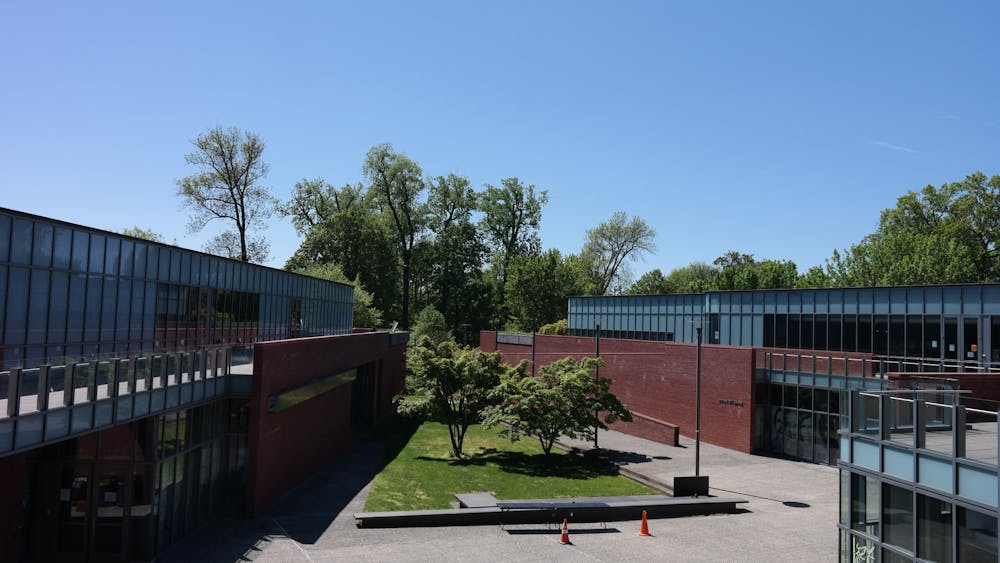
Well, in the middle of those eras was the Mattin age. To look up 33rd then, according to some of the articles I found, was to glimpse an ambitious, but more “inward facing” Hopkins; see the Mattin Center up there, with its courtyard tucked away from street view. Perhaps, but like today, the Hopkins of Mattin was more than what it appeared to be from the street. In the interior of the space, away from the politics of the place, oblique brick walls enclosed gently sloping concrete walkways and rows of those chilly-looking glass panes. They might not have been the fanciest materials, but they were “warm, simple, and cohesive,” clearly “built by human hands,” according to The Architect’s Newspaper. Mattin seems to me to have had a unique, folky quality. That quality was also part of the bones of the place, and part of the bones of Hopkins throughout the beginning of the century.
All these stories. Some barely past and some ancient, at least by Hop standards. Stories from an old horse stable, from the Levering upstairs, from the ghost of a departed arts center. All these old stories, and then, the new colossus. Let’s start with this perspective: of course I found it difficult to feel the dirt underneath the Stuce. The place is unprecedented. Nothing so sunlit (my god those windows) so huge (3x the square footage of Mattin, and TALL) so satiating (still haven’t tried all the stalls) and so social (you’ll walk through and come across four people you know and end up late for class) has ever existed at Hopkins. We’ve come along way from a cow barn. At the same time, though, the Stuce is like any other center: what ultimately matters are not the attributes, but the emotions and the memories. As the place fills with new stories, the gap between those gigantic plates of fritted glass and the more grounded architecture of Hopkins’ past will smooth over. What was once unprecedented will also become warm. I went to the Stuce with my friend the other day. We sat on the roost. She made a joke about the tin man. I will not reproduce it here. We laughed until we nearly died.
sources
“Merrick Barn: Past and Present,” The Johns Hopkins News-Letter, March 2024, https://www.jhunewsletter.com/article/2024/03/merrick-barn-past-and-present
“A Brief History of Levering Hall,” Johns Hopkins Hub, Feb. 16, 2026, https://hub.jhu.edu/2026/02/16/history-of-levering-hall/
“30 Great Things About Hopkins,” Johns Hopkins Gazette, April 30, 2001, https://pages.jh.edu/gazette/2001/apr3001/30great.html
“Mattin Center: A Reflection on Architecture and Impermanence,” The Architect’s Newspaper, June 2025, https://www.archpaper.com/2025/06/mattin-center-reflection-architecture-impermanence/