I don’t know if I’m a person who believes in signs. The cosmic type, like butterflies gracing your fingertips or a light illuminating a fork in the road, not stop or yield signs. If I am, though, then I can think of a handful that seduced me to come to Hopkins, and they date back to before I was even accepted.
Flashback to March 2024, the Association of Writers & Writing Programs (AWP) in Kansas City, Missouri (KCMO).
AWP is the largest writing conference in the United States, hosted by a different city every year. When I was a senior at my high school in a suburb of Kansas City on the Kansas side, the city that hosted that year was KCMO. My English teachers, who knew I wanted to become a writer, bought me a student pass with their budget. I skipped two days of school that week, carpooling with my mom as she went to work and dropped me off at the convention center along the way.
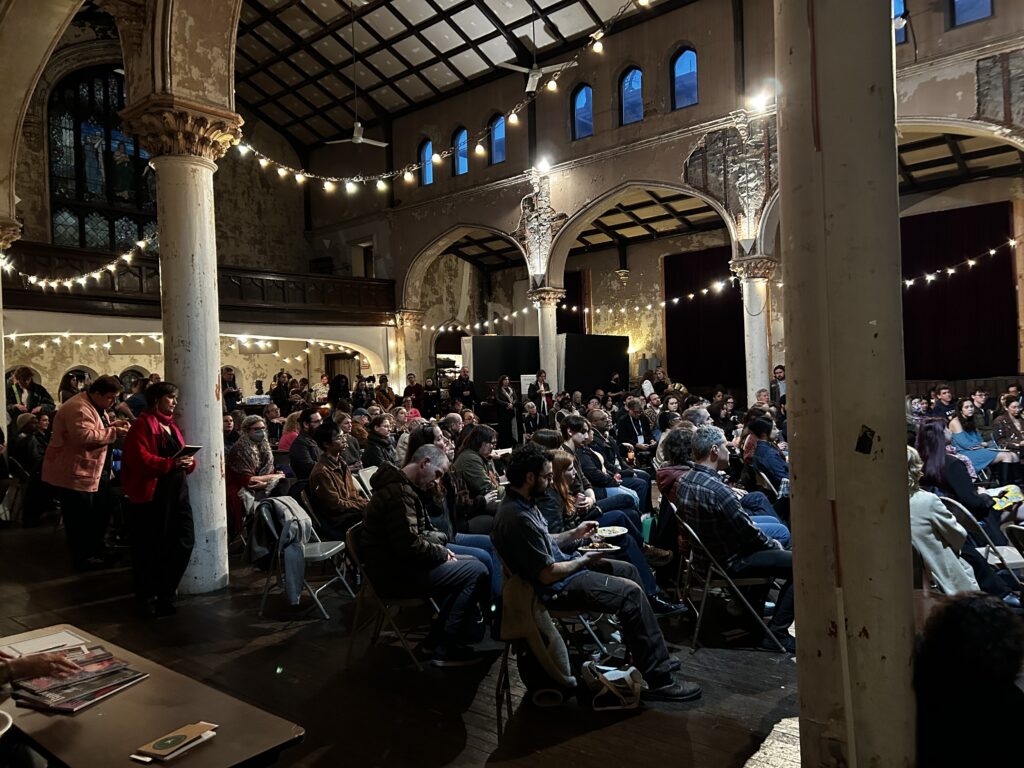
In a room full of writers or people somehow tethered to the craft, it’s a fruitless competition of who can be the most individual. While that may sound stressful or toxic at first, it quickly dissipates into recognizing that everyone is ironically the same in just how individual they are. That day, I saw more colors of dyed hair bobbing in the sea of heads than I had fingers to count. There were piercings in places I didn’t know metal could skewer. Cloth was draped across bodies in fashions that were ancient yet futuristic, modest yet risqué, chic yet camp.
Beyond my first foot into AWP being a trial of independence—to be there alone, a high school student among career writers—it was a test of individuality, one that I wouldn’t recognize yet as perfectly parallel to setting foot on a college campus for the first time.
So, I attended panels and jotted notes on a yellow legal pad that I carried around in a thrifted New Yorker tote all day. Those were the environments I was comfortable in: glorified classrooms. But I wanted the full experience, regardless of if I was prepared or not. I went to the Bookfair, a place mostly for networking or learning about different organizations and publications. (You could, of course, also purchase books there.) In case you couldn’t guess, as a high school student, I had no strict business being there, no true network-worthy ambitions or means. It was like a girl scout cookie stand setting up shop beside a gallery auction.
Quickly, however, I found my groove, or a cheat code of sorts. I serpentined the aisles of booths, scanning both sides for the names of literary magazines I recognized as being affiliated with colleges I had applied to. As an editor and designer for a teen literary magazine at my local library, I felt that was the arena in which I held most purchase. My first few cold interactions with booth attendees taught me that, when I walk up and tell them I’m a student who’s applied to their program, the assumption is not high school senior, but college senior. They mistook me as a hopeful MFA applicant, my mustache and height certainly not helping.
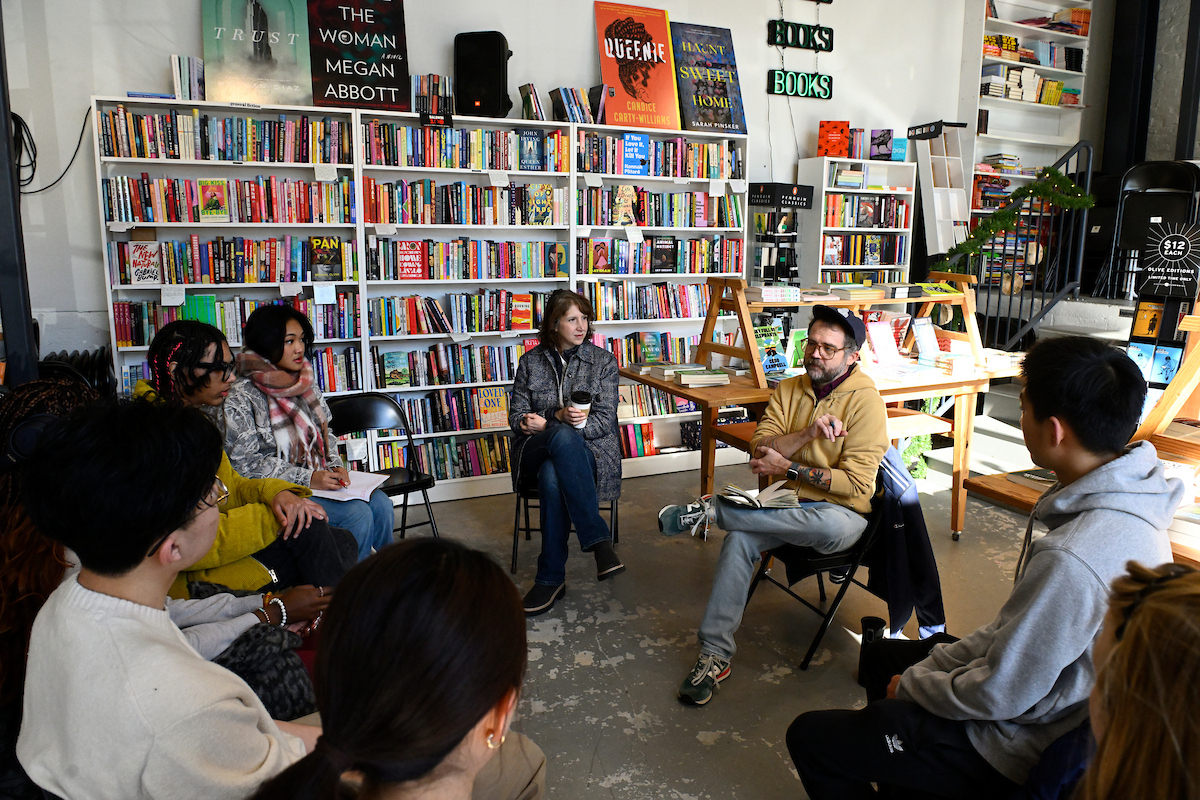
By the time I found the booth belonging to The Hopkins Review—The Writing Seminars’ journal of literature and culture—I had honed my strategy. There, I met Dora Malech, editor in chief of The Hopkins Review. She provided me with a cordial, warm welcome and overview of the journal, handing me a copy to flip through. I asked if undergraduates could be involved, to which she responded yes—foreshadowing, readers! It was just a coincidence—or a sign?—that immediately after stopping by The Hopkins Review’s booth, I was scheduled to go to a reading by Susan Choi, professor in The Writing Seminars. About two weeks later, I was accepted to Hopkins, and it was the only school for which I felt I had a read on not only the vibe of the institution, but the faculty of my particular major.
Flash forward two years. Setting: March 2026, Baltimore. The occasion, once more, AWP.
Few 19-year-old writers, I imagine, are as lucky as me to say they have attended AWP twice, both times having the conference hosted in their city of residence and both times having their tickets comped. So goes my life of happy accidents—or signs?
This year, I was on the opposite end of the booth, representing Hopkins, Writing Seminars, and The Hopkins Review to conference attendees from everywhere you can imagine. Still, between Hopkins-specific panels, I was able to attend ones out of pure, selfish interest: a panel on creative writing in the K-12 classroom; another on poets and writers engaging archives.
I felt déjà vu while I stood behind the folding card tables, answering questions about The Hopkins Review from the perspective of an Editorial Assistant when, only two years before, I was a stranger to this school in its entirety. To be honest, no one was looking for the sales pitch I had prepared. Most people just wanted free bookmarks, stickers, or to purchase an issue or subscription.
Lightning never strikes twice. The likelihood of finding a “me-reincarnated,” some high schooler at AWP who applied to Hopkins and was visiting their booth anxiously before his decision was released, proved to be zero. The closest I came was finding two adults from St. Louis, Missouri—a far cry from my hometown in Kansas, but something nonetheless—though they seemed totally uninterested when I shared this. Still, none of that stripped the novelty and dearness of this three-day conference, or even just my three-hour shift tabling. Instead, the novelty became the fact that, in only two years, I had the privilege to find myself in a foreign city halfway across the country, nevertheless perfectly at home within a new community, one forged by Hopkins.