By Etina R., ’30
Flipping over rocks under the imposing maple tree in my front yard, I was looking for two things: roly pollies to stash in my Roly-Poly Playground and earthworms to feed the forever hungry chickens roaming my backyard. Looking at these invertebrates that could easily fit in the palm of my hand, made me feel almost as large, strong, and invincible as the maple tree looming above me. But a maple tree isn’t the strongest, largest, or most resilient tree that exists; I wanted to be a Giant Sequoia.
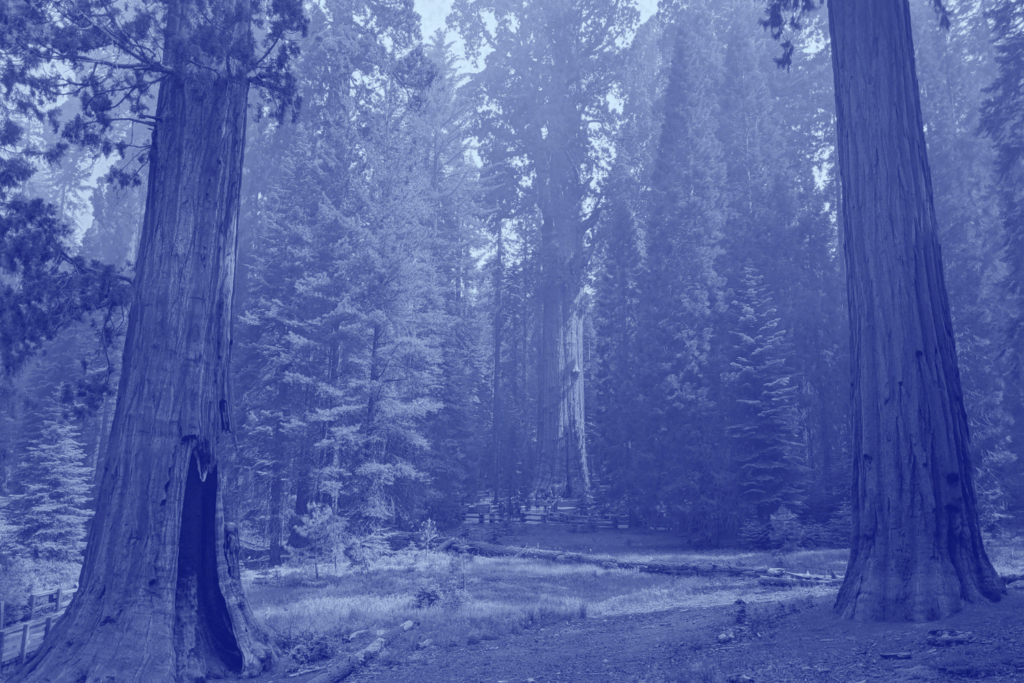
If maple trees seemed to touch the clouds, Sequoiadendron giganteum trees seemed to enter the mesosphere. Not only are they larger than any other tree species, but they have also evolved a thick, fire-resistant bark allowing growth to continue even after a ravaging fire in their ecosystem. In math and science, I am and always have been a Giant Sequoia, able to withstand countless derivatives, integrals, organelles, and principles blowing my way. In humanities classes, subjectivity covers all three hundred feet of my trunk and limbs in Pueraria, and my likeness to a sequoia is proven through the resilience needed to strip the vines of uncertainty off and see the beauty of the tree beneath.
Being in high school, I often feel like a cottonwood with a pliable, shallow root system that hasn’t yet evolved to withstand the storm that is life. I am held upright largely due to the interconnection of my root systems with like-minded peers and friends I have found through orchestra, classes, and school clubs. However strong the power of community is, in college I long to develop a deep root system of both knowledge and self-sufficiency that can keep me upright, regardless of what happens to the connections that, right now, are crucial to my survival.
The Castanea dentata, the American Chestnut, taught me to value individualism through the permeation of a fungus that ran rampant and eliminated most of the formerly populous species in the United States. Being a lone tree can limit the stresses of altruism, having each effort contribute to just myself rather than spreading through a group, making it incredibly easy to exist as a lone tree in class, absorbing nutrients accumulating ring after ring of knowledge. However, if the Giant Sequoia’s sprawling, intertwined root systems taught me anything, it was that collaboration, feedback, support, and the melding of ideas allow my community and I to have a strong foundation that can resist even the strongest of winds. I am seeking to integrate into an environment in which I can continue to live in that delicate balance between my community and individual development.
While I may aspire to be like a Giant Sequoia, my confidence more closely resembles a Fraxinus tree, of whom millions have been slain by tiny Agrilus planipennis, better known as Emerald ash borers. The strong scores that made me rise to the top in high school should imprint a sense of confidence, but confidence is easily eroded by self-doubt and a focus on the tiny mistakes that remain and drive me to keep improving myself. Only by acknowledging such vulnerabilities and working within a community of friends and mentors can I improve upon them and grow from a sapling filled with hope and potential to become the well balanced contributor to my communities that the seedling who stared at the maple leaves looming above longed to be.
Comentarios del Comité de Admisiones
In her essay, Etina uses her knowledge and passion for trees to signify community, resilience, and putting down roots. The tree metaphor effectively communicates a student who thinks across disciplines in a reflective way. We also see a thoughtful balance between community and individual growth, which suggests an understanding of the kind of learning environment where she would thrive.
From her essay, we see a student who values belonging, mutual support, and shared growth, and we can picture how she would enrich our Blue Jay community. The essay is especially effective when it uses the natural world to reveal something personal about confidence, development, and the process of becoming a more grounded, independent learner.
Etina R.“The hardest part of writing my personal statement was writing about myself; everything I typed felt disingenuous and lacking in context. To combat this, I explored interests of mine that weren’t apparent in my application in hopes that it would bring an approach that felt more genuine. I landed on trees and used each species to highlight a characteristic of myself. By eliminating the expectations of what I thought a personal statement should be, I was able to overcome the hurdle of starting and represent myself genuinely.”