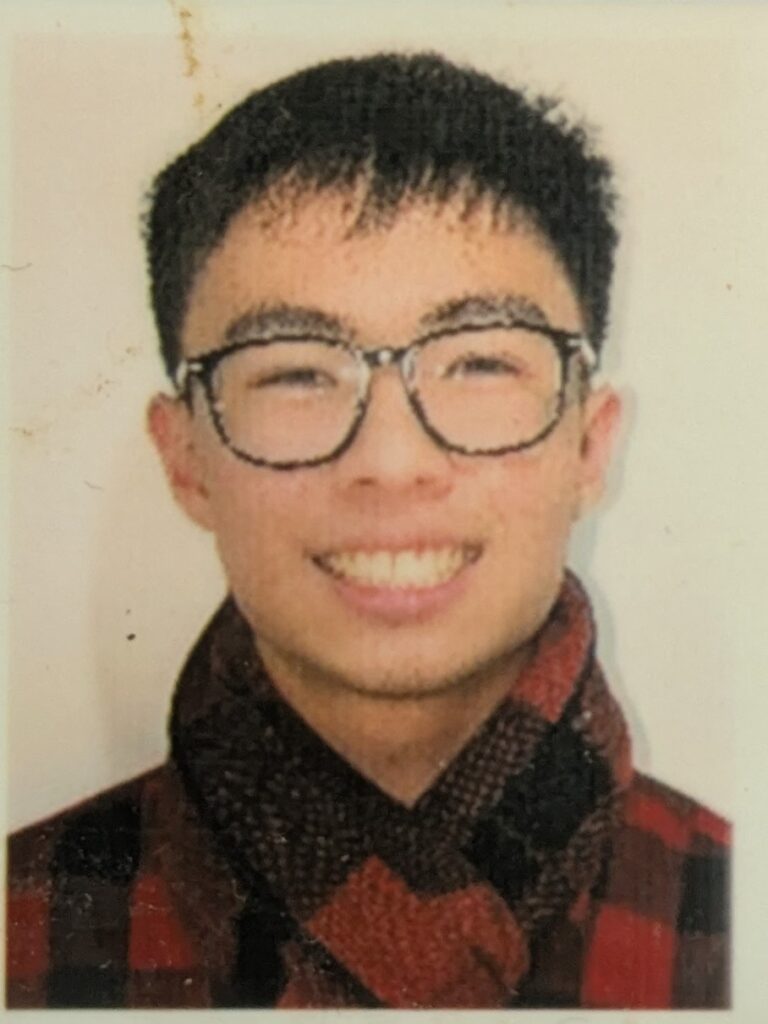
Albert H. is a senior from Rockville, Maryland. Albert started at Hopkins as a history major, took organic chemistry for the fun of it, switched from history to a double major in physics and math, and will head to Georgetown Law in August.
I met Albert in a math class last fall, and I reached out to him again today, to understand the remarkable story of a true Hopkins Renaissance man.
This interview took place in May 2026. The following has been edited for brevity and clarity
First: What brought you to Hopkins?
Well, starting in fourth grade, I was enrolled in a series of math and science schools. Then in high school, I thought I’d aim high and apply to a bunch of places. What was appealing about Hopkins was that it was a top university, but it was also close to home, so when I got in, it was my top choice.
You mention math and science. Did you enter your first year intending to major in those subjects?
I’ve always been a little bit of a contrarian, so because I was surrounded by people who love math and science, I sort of ran toward history. But very quickly I discovered that what I found interesting about history, which was reading all these things, was very different from the practice of writing history: being very careful about how you’re structuring your writing and how you’re going through the archives.
I mean, I liked my history peers a lot. My best friend is a history major, and I met him in the required class for sophomores—we were both taking it our first year just to be extra. But I knew studying it wasn’t going to be for me.
So, you moved into math and physics in your second semester of your first year.
Yes.
This is a very diverse, liberal-arts-style education. What was that experience like at Hopkins?
I really liked being able to dive deep into multiple subjects, and to see the connections. For example, one time I took a philosophy class about Baruch Spinoza. The really interesting thing about that was that Spinoza was also a physicist. The ways of thinking are actually quite similar. Philosophy is trying to do for humanities something very similar to what physics is trying to do for science.
Obviously, there are slight differences. Philosophers might ask open-ended questions that have to do with phenomena and experience, whereas I think the STEM brain makes someone more pragmatic about the questions they’re asking. It’s interesting to see that interaction between two different ways of thinking about logic.

(Barend Graat, 1666)
So that’s physics. Where does the math major come into this?
Math is just really fun! I think the value of having studied math in my life is going to be, like, training the logical part of the brain. Sometimes in history and philosophy and writing, and even physics, we can be very loose with how we define an argument. Math forces us to be precise about everything. I really, really enjoy that. It has helped me become better at dissecting a historical argument I’m reading or writing.
It’s funny–you’re kind of closing the circle. Like, maybe I could interpret those historical texts from my first year more effectively now.
Yeah, for sure.
And so, you will carry these majors in math and physics to term in, uh, two and a half weeks. But then, you’re going to go to law school. What inspired this most recent turn?
I wanted to feel like there’s a meaningful impact from the work I’m doing. I think we’re in a very interesting time period, where the country and the world are facing a prolonged social and political crisis. So that’s why I ultimately decided to transition to law rather than go to graduate school.
Actually, Hopkins has kinda put itself at the center of this. You see this through President Ron Daniel’s democracy initiatives. He was very early on this train that the university is at the heart of how we can resolve this. It’s a very optimistic vision.
Okay, quick shift of gears, making sure I cover all my bases: what about the more…everyday part of being at Hopkins?
Hopkins reminds me of home in a lot of ways, not only because it’s just an hour’s drive from where I’m from. The culture is very similar to the schools I’ve attended before. Most people are just nerds who are normal people but also focused on their work and their research. That’s the kinda people I want to be around. I’m partial to people who aren’t quite well-adjusted; I was talking to my best friend about that. People I keep close have to be a little weird like I am.
What would you say is the best class you’ve taken?
That’s really hard to say. I just don’t know. I loved all the classes I took here. I wouldn’t say there’s one where I regret having taken it.
What about favorite professors?
There are so many cool professors I’ve had here. The Writing Seminars is amazing because we have one of the best MFA programs in the country. Every Writing Seminars professor I’ve met has such personality and enthusiasm and is very good at teaching, which is sometimes rare at a good college, where the professors might be more worried about research than education. But these people are writers—they’re very good at imparting their craft, and they’re all funny.
That’s the thing, authors and artists are very eccentric. And also, I said physicists were kinda like poets, and as it happens, the physics professors are all very colorful too. I really liked the eccentricities of teachers. It’s cool when they bring a little bit of where they disagree with the rest of the field or bring their own sense of humor into where they teach.
Favorite spots?
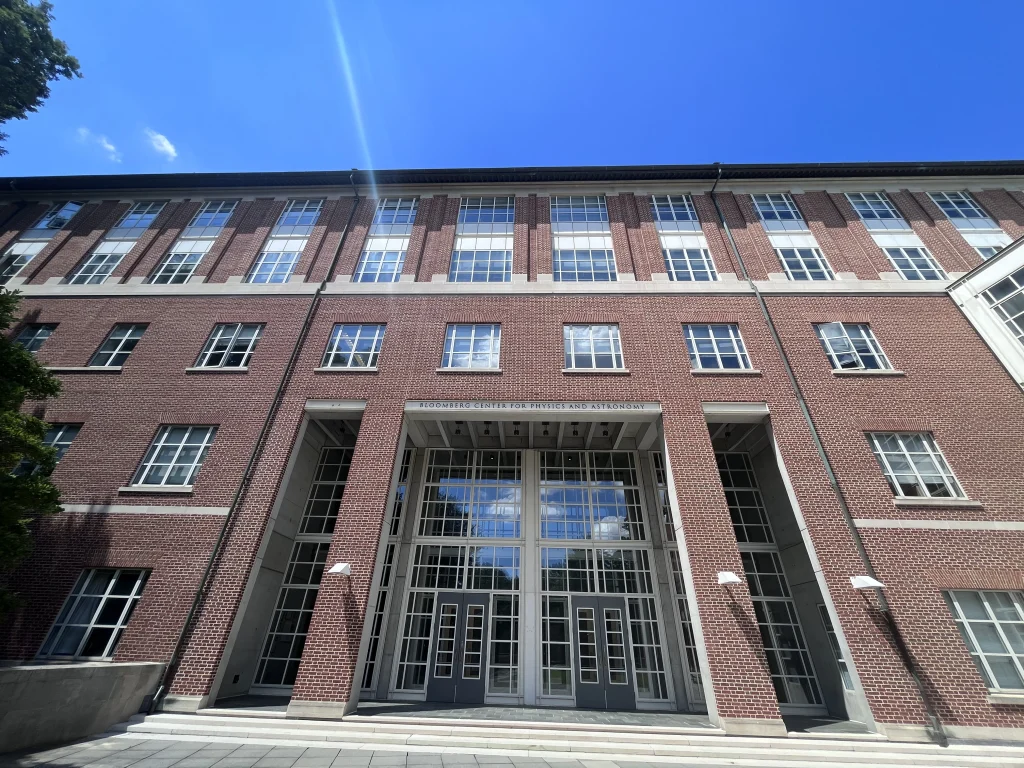
Other than my apartment? Behind the Bloomberg Center for Physics and Astronomy is beautiful. I study in Brody a lot. Gilman Hall has a nice atmosphere, but it’s always too cold in the spring, that is what I’ve learned. The new Bloomberg Student Center is nice, it’s pretty, but I guess because it’s new to me, I’m not very comfortable there yet. I’ll always have a soft spot in my heart for the Bloomberg Center for Physics and Astronomy, even though it’s, you know, brutalist.
And I also like right by the Undergraduate Teaching Labs; all the little gardens…there’s a reason why when people visit. They always say we have a particularly nice campus. It’s very special here.
How are you feeling about ending your time at Hopkins?
I’m excited. Actually, I still have a paper to write for one of my classes. But once that’s done, I’m excited to take a little break—and then get straight to learning about the law!